
GREAT BAY/MARIGOT, St. Martin: Tobias Schank, a German author and researcher of North American Literary and Cultural Studies at Saarland University, has focused his recent paper on what he calls “a selection of texts from Euro-Caribbean borderlands, specifically the pan-Caribbean poetry of Lasana M. Sekou as well as the prose of Tiphanie Yanique from the wet borderlands comprising Saint Martin/Sint Maarten and the British/U.S. Virgin Islands, respectively, as well as the sea and its (more-than-)human agents that connect these islands.” Dr. Schank’s paper, “Blue bordertexturing: (un)knowing Caribbean wet borderlands,” sets out to ground what he describes as an “experimental approach in a productive theoretical fusion... .” It appears in Environment and Planning E: Nature and Space, published by SAGE Journals in October 2026.
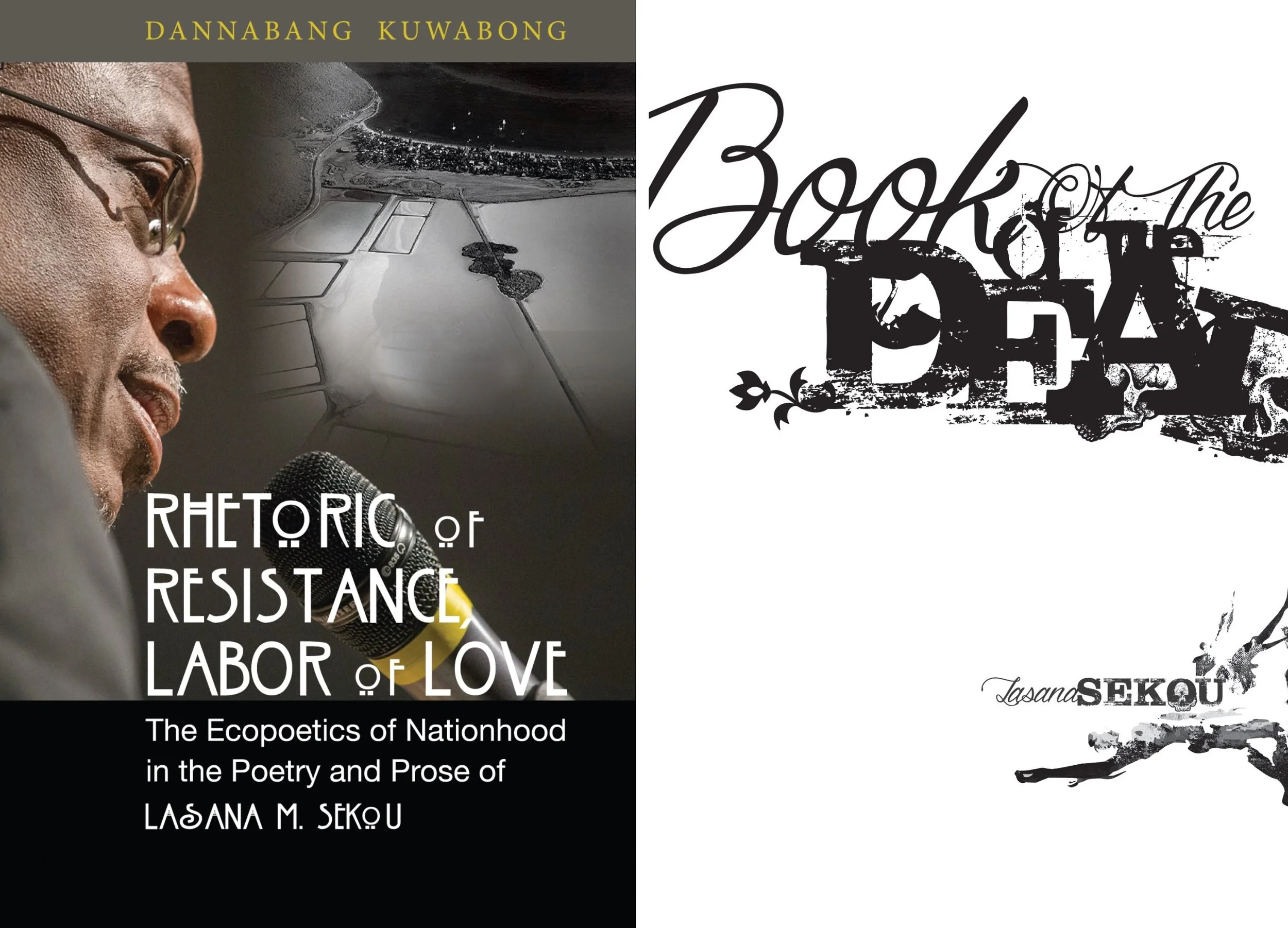
The peer-reviewed journal article offers a critical examination of the ocean and seascapes “as one of humanity’s most compelling, inspiring gateways to explore (non-)human coexistence.” One of the books by Sekou that Schank examines closely is Book of the Dead, published by House of Nehesi Publishers (HNP). “Poems such as ‘daylight come, oui,’ ‘Poem for the dead’ (for kamau brathwaite), and ‘sweet lil’ s’maatin’ (for masso arnell) were among Lasana’s writings that Schank drew on while building his complex argument about ‘Caribbean wet borderlands,’ along with quotes from Yanique’s novel Land of Love and Drowning (2014) and an array of references from experts in the field of study,” said HNP president Jacqueline Sample. “What I find fascinating is how Dr. Schank also draws from Lasana’s work when discussing aspects of fresh or emerging critical takes on decolonial thought, though Book of the
Dead was published in 2016,” Sample added. Another book examining St. Martin’s history, people, culture, and landscape is Rhetoric of Resistance, Labor of Love: The Ecopoetics of Nationhood in the Poetry and Prose of Lasana M. Sekou by Dannabang Kuwabong. A significant feature of the island’s landscape explored in the book is the Great Salt Pond, which Sekou has long described as a shamefully neglected, polluted, and diminished wetland. He insists, however, that it remains the island’s historical and cultural “cradle of the nation.”
Rhetoric of Resistance was also the subject of a review essay by Yvette M. Alex- Assensoh, Ph.D., J.D., published earlier this year in African and Asian Studies, the peer-reviewed academic journal published by Brill, Sample noted.
Kuwabong’s five-chapter book is a “very useful and sophisticated study” of Sekou’s work, said Dr. Alex-Assensoh, a professor of political science and adjunct law professor at the University of Oregon. The reviewer’s analysis of Kuwabong’s work casts a wide and sharp net. “Ideologically, Professor Kuwabong utilizes J. Clarke’s eco-Marxist theory, as he stressed, from Greg Gerard’s perspective that Sekou’s salt of ponds do reflect a poetics of relations built on a philosophy of egalitarianism; and that in ‘Great Salt Pond Speaks,’ Sekou humanizes the pond through his voice.” Dr. Alex-Assensoh concludes that, alongside other titles by Kuwabong, his HNP book Rhetoric of Resistance, Labor of Love is “very suitable for classroom use on college-cum- university campuses.” Beyond the two journal publications discussing Sekou’s work, a recent conversation between Sekou and Christina Kullberg informed a key part of the introduction to her article, “Listening and responding to hurricanes: Ana Portnoy Brimmer and Caribbean immersive poetics,” published in Textual Practice in August 2026.
The article “traces a shift in Caribbean literature’s engagement with hurricanes since Irma and Maria,” said Dr. Kullberg, who specializes in Caribbean literature, travel writing, translation studies, and world literature. Referring to Sekou’s expression about the “literary responses to the historical and contemporary tragedies wrought by natural disaster,” Kullberg draws attention to the “expression of literary engagement with the materiality of hurricanes and the material afterlives of storms.” Dr. Kullberg’s endnotes, Sample noted, reference authors and scholars from beyond the Caribbean and from the region’s leading and also emerging authors such as Édouard Glissant, Kamau Brathwaite, Frankétienne, Celia Sorhaindo, and Richard Georges. They also include HNP’s disaster titles by Fabian Adekunle Badejo, Yvonne Weekes, and Wendy McMahon. Textual Practice, a peer-reviewed journal published by Routledge, contains “some of the most path-breaking, adventurous critical writing currently to be found in Britain,” said literary theorist and critic Terry Eagleton. Optional subheadline: New research draws on the poetry of St. Martin’s Lasana M. Sekou and the prose of Virgin Islands’ Tiphanie Yanique to examine Caribbean wet borderlands and the wider meanings of sea, place, and (non-)human coexistence.
